If you are a small business owner in Brisbane, you have likely been told that AI is the future. But before you rush to buy the latest tools, there is a “secret skill” you need to master first: process mapping.
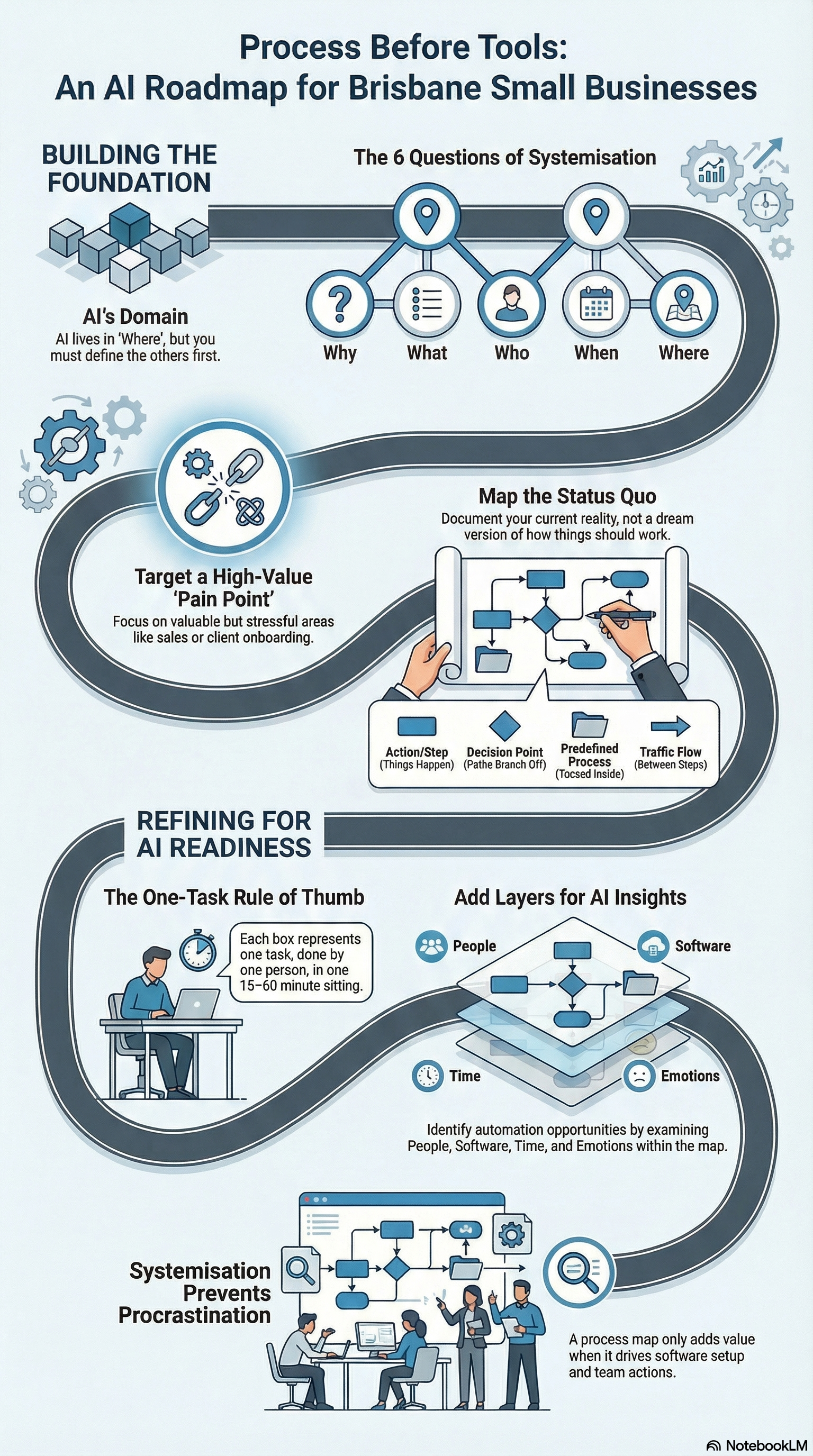
Many businesses try to solve their problems by jumping straight to the technology — the “where” of the business. However, if you don't understand your underlying process, you risk simply automating chaos. To truly systemise your business, you must first be able to answer six core questions: Why are we doing it? What needs to happen? Who is doing it? When is it happening? How do we do it? And finally, where do we keep track of it?
Process mapping is a form of visual storytelling that makes invisible actions visible, allowing you to understand the big picture before you invest in AI.
1. Identify Your “Pain Points”
Don't try to map your entire business at once. Instead, pick one area that is valuable but currently a pain point. If something is not quite working but is worth fixing, that is your starting point. Common examples for small businesses include:
- Onboarding new clients.
- Sales processes (from lead to closed sale).
- Sourcing vendors or hiring talent.
- Handling client change requests.
2. Define the Scope
Every good story needs a beginning and an end. When mapping a process, define your start and stop triggers. For a sales process, the story might start when you “receive a lead” and end when you “close the sale” or “close out the lead.” Keeping the scope tight helps you focus on the good stuff without feeling overwhelmed.
3. Use the Four Universal Symbols
You don't need to be an artist to map a process. You only need four basic symbols:
- The Rectangle: Represents a step or action where things happen.
- The Diamond: Represents a choice or decision point where the path can branch (e.g., “Do we have enough info to proceed?”).
- The Folder: Represents a predefined process — a complex set of steps you can “tuck away” to deal with later so your map stays clean.
- The Arrow: Shows the flow of traffic from one step to the next.
4. Map the “Status Quo” (Not the Dream)
A common mistake is mapping what you wish was happening. Instead, you must focus on reality. Ask yourself: “What happens first?” and then “What happens next?” until you reach the end.
A good rule of thumb for detail: Each box on your map should equal roughly one task. A task is something done by one person in one work sitting at a discrete time (usually taking about 15–60 minutes).
5. Add Layers to Spot AI Opportunities
Once you have the basic steps, you can add “swim lanes” or layers to make problem areas obvious. This is where you identify exactly where AI can help. Look at:
- People: Who is involved? This highlights where “handoffs” between staff might be causing confusion.
- Software: What tools are you using at each step? You may find you are manually moving data between systems that AI could bridge.
- Time: How many minutes does each step take? This helps you solve challenges around turnaround time or high costs.
- Emotions: How does the client feel? Mapping the emotional experience can help you solve issues like “client drop-off” or “ghosting” by identifying where they feel stressed or bored.
From Map to Action
A beautiful process map is only useful if it leads to action. Once you have visualised your workflow, you can then move to the final step: setting up the software and AI tools that will support your team. By focusing on the process first, you ensure that your technology actually makes your business more efficient, rather than just more complicated.