1. The Challenge: The Context-Switching Bottleneck
In a traditional business environment, AI assistants often operate as isolated silos. While powerful, these tools are historically restricted by an inherent inability to natively access external business systems. This operational limitation creates a significant technical bottleneck: every integration between an AI and a platform like a ticketing system or documentation vault typically requires unique, custom code. Without a unified interface, AI remains a “closed box” regarding live company data.
For technical staff, this fragmentation translates into a manual “context-switching” burden. Technicians are forced to manage numerous open browser tabs, constantly jumping between ticketing platforms, technical documentation, and security logs to gather the facts needed for a single task. This necessity to manually bridge the gap between tools hinders efficiency and slows down service delivery.
2. The Solution: MCP as a Universal Business Adapter
To resolve these architectural hurdles, Mino IT implemented the Model Context Protocol (MCP). MCP serves as a standardised interface between Claude (specifically Claude Code running in VS Code) and the Mino IT toolset. By acting as a universal adapter, MCP allows Claude to understand natural language and interact directly with business systems — performing multi-step tasks with no scripting required from the technician.
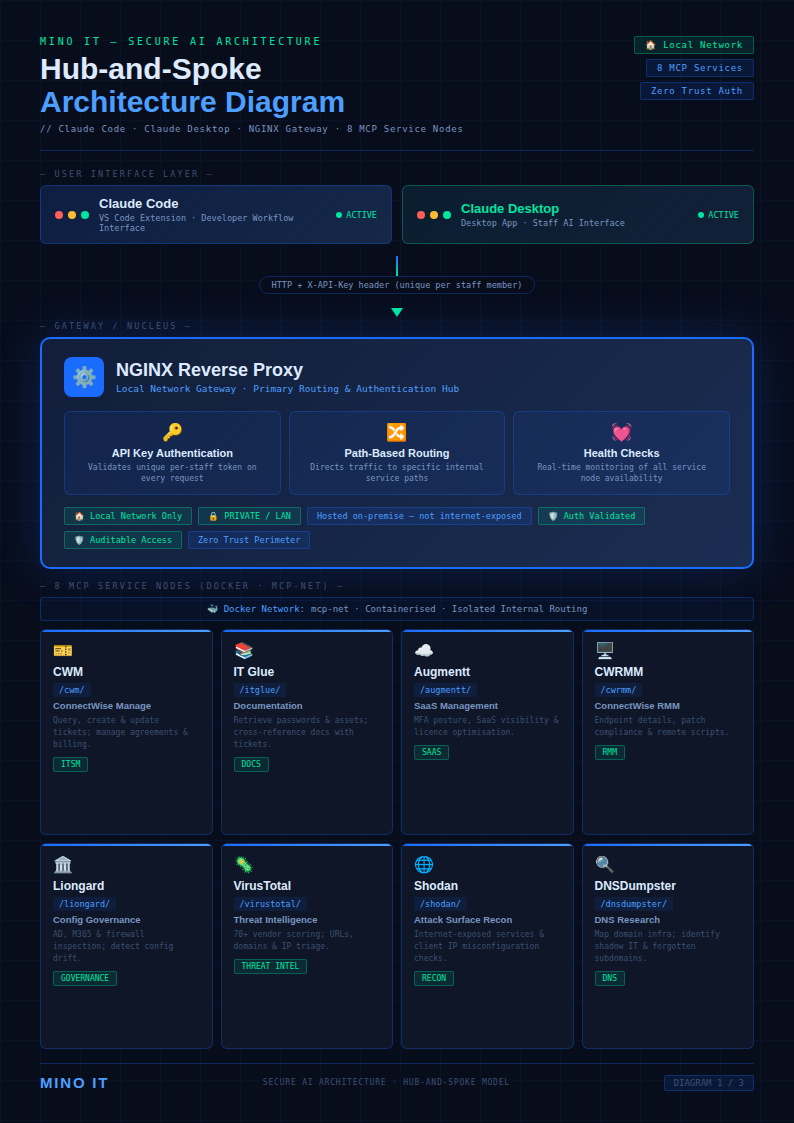
Mino IT has integrated eight core systems via MCP, utilising a mix of Python and Node.js servers to provide a unified technical environment:
- ConnectWise Manage (/cwm/) PSA — Python: Query, create, and update service tickets; review billing and agreements.
- ConnectWise RMM (/cwrmm/) RMM — Node.js: View endpoint details, check patch status, and execute remote scripts on managed devices.
- IT Glue (/itglue/) Documentation — Node.js: Search configurations, retrieve passwords, and cross-reference documentation with tickets.
- Augmentt (/augmentt/) SaaS/Security — Node.js: SaaS application management, visibility, and MFA posture and compliance reporting.
- Liongard (/liongard/) Deep Inspection — Node.js: Detect configuration changes over time and perform deep inspection of AD, M365, and firewalls.
- VirusTotal (/virustotal/) Security: Analyse URLs, domains, and file hashes via threat intelligence from 70+ security vendors.
- Shodan (/shodan/) Security: Discover internet-exposed services, ports, and vulnerabilities on public-facing assets.
- DNSDumpster (/dnsdumpster/) Security: Map domain infrastructure and identify shadow IT or forgotten subdomains.
3. Security-First Architecture: Engineering for Trust
The implementation follows a strict “least-privilege” and “security-gatekeeper” model to ensure that AI-driven automation is as secure as it is efficient. The architecture is built upon four specific pillars:
- Reverse Proxy Gateway: Serving as the central gatekeeper, the gateway provides API key authentication, path-based routing, and continuous health checks for all MCP traffic.
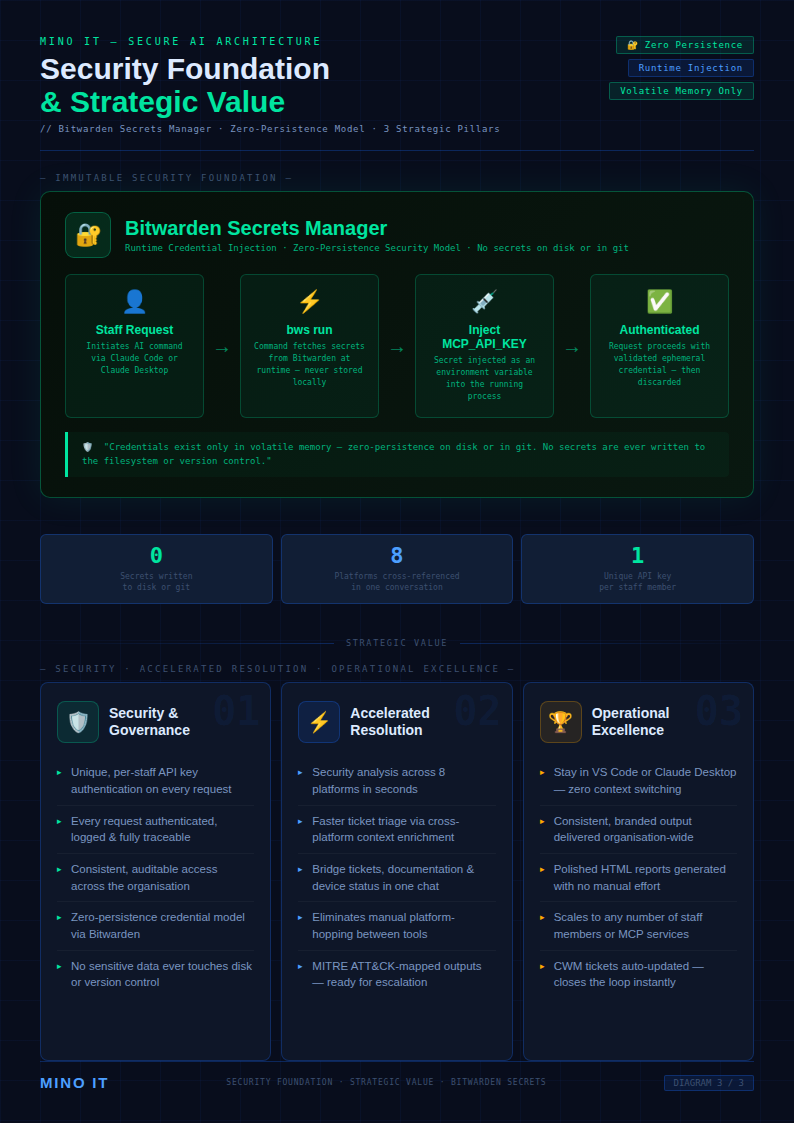
- Role-Based Access Control (RBAC): Every staff member is issued a unique API key validated at the gateway. These are stored securely in each technician's local environment and are never committed to code, ensuring every AI request is traceable and accountable.
- Network Isolation: All infrastructure resides within a dedicated internal Docker network. MCP servers are isolated on their own IP range, preventing unauthorised lateral movement within the environment.
- Secrets Management: Mino IT utilises an enterprise secrets manager to inject credentials at container startup, ensuring that no API keys or tokens are ever stored on local disks or in Git repositories.
4. Operational Impact: The “Context Enrichment” Skill
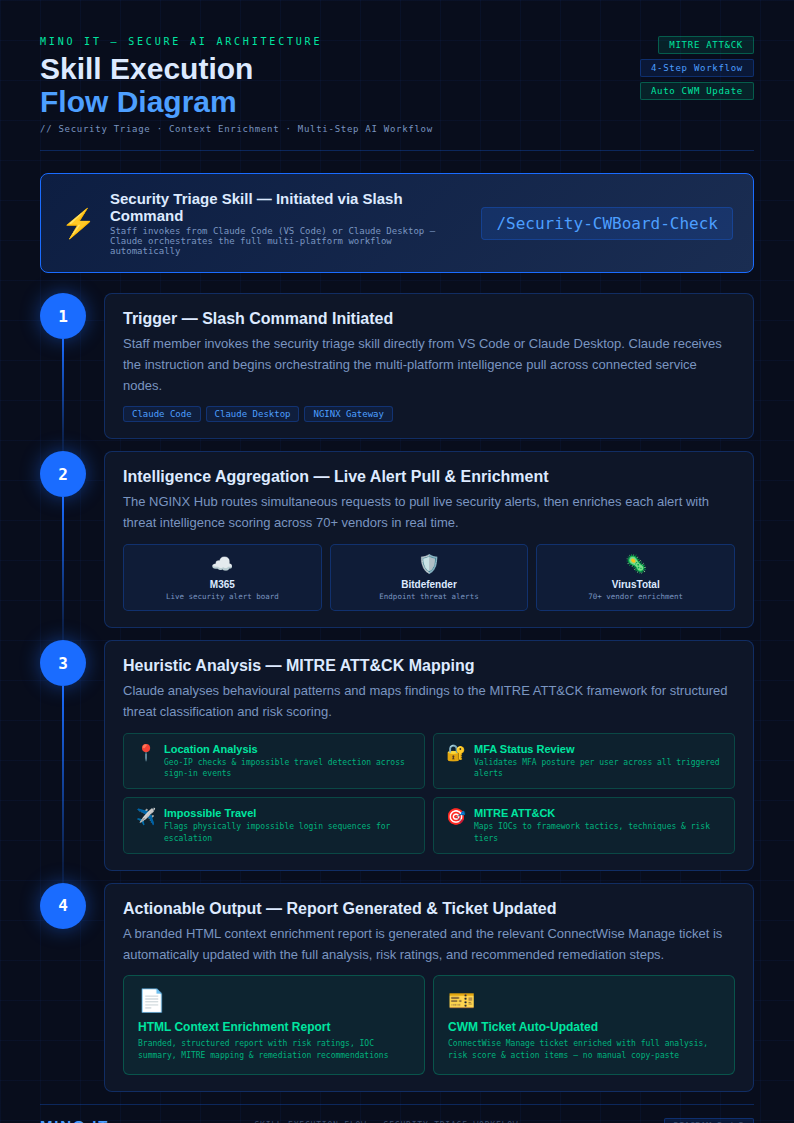
Mino IT uses “Skills” — pre-built workflows that chain together Claude's AI logic with multiple MCP servers for one-command automation. By typing a command like /Security-CWBoard-Check, a technician initiates a multi-step automation that queries APIs, analyses data, and generates a branded report.
This capability, known as “Context Enrichment,” provides a 360-degree view of the environment in real-time. A single prompt allows the AI to pull ticket details from ConnectWise, check device health in the RMM, and verify security configurations in Liongard simultaneously.
Efficiency Comparison
| Scenario | Process | Time |
|---|---|---|
| Before | Manually search IT Glue configurations, cross-reference M365/Liongard snapshots, and review security logs across multiple tabs. | ~30 minutes |
| After | Multi-step automation chain performs the same pattern recognition and data synthesis, providing an instant, actionable triage report. | Seconds |
5. Client Outcomes and Strategic Value
By bridging the gap between fragmented data and AI, Mino IT has achieved material improvements across service delivery.
Operational Improvements
| Metric / Area | Business Impact |
|---|---|
| Time to Resolution (TTR) | Accelerated via instant triage and documentation lookup without leaving the VS Code workflow. |
| First-Time Fix Rate | Improved through a complete 360-degree view of users, devices, and security posture. |
| Security Posture | Rapid triage of suspicious indicators against VirusTotal and Shodan for analysis in seconds. |
| Auditability & Compliance | Full traceability of every request via per-staff unique API keys and logged channels. |
6. Conclusion
Through the strategic implementation of the Model Context Protocol and a security-hardened architecture, Mino IT has successfully bridged the gap between fragmented data silos and actionable intelligence. This platform is currently live and available for all staff, ensuring that service delivery is consistent, secure, and rapid.
By empowering engineers with real-time, cross-platform data directly within their workflow, Mino IT continues to set the standard for modern managed services.